agen+cy
Agentic Web Design as Entertainment

DISCLAIMER: This is rough software. It was vibe-coded in a semi functional state. I don’t know how expensive it will be if you run it, it’s probably full of bugs, and I am sorry for that. Use your own keys at your own risk.
This is a quick AI edited reflection on a Proof of Concept called Agen+cy. I’m between projects right now and decided to mess around with the latest iteration of vibe coding tools. This is just a snapshot of my thoughts—a way to get this to a state where I can post it, feel like it’s a “done” project, and move on to the next shiny object.
Agen+cy is a workspace sitcom that writes code.
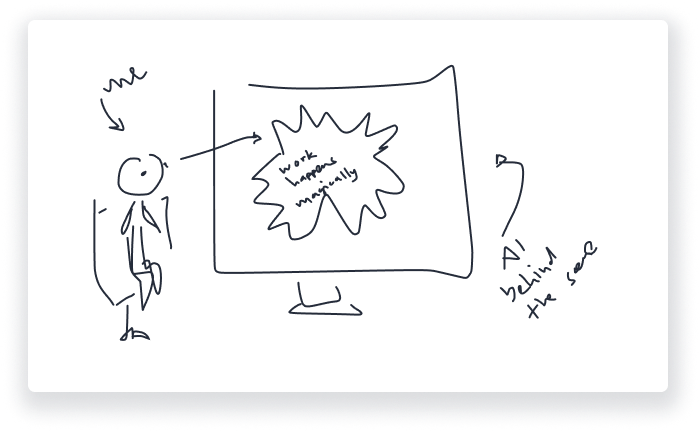
Think of it as watching LLM API calls manifest themselves as a reality TV show—productive output mixed with a lot of cringe conversations. In this show, we have a cast that builds a fully functional landing page live:
Kevin (The PM): Over-enthusiastic, loves “syncs,” hates scope creep.
Ramona (The Designer): Uses too many emojis, deeply cares about border-radius.
Rich (The Design Engineer): Just wants to ship, tired of Kevin’s syncs.
Marc (The Intern): Tries his best, breaks the build occasionally.
0xNonSense (The Copywriter): Writes crypto-bro marketing slop until you rein him in.
You, my friend, are the Client. You give them the brief, and they start brainstorming, creating tasks, and coding right in front of you. All you need to do is lean back, watch the chaos, and when you see something you like, pause and download the file.
Technical Details
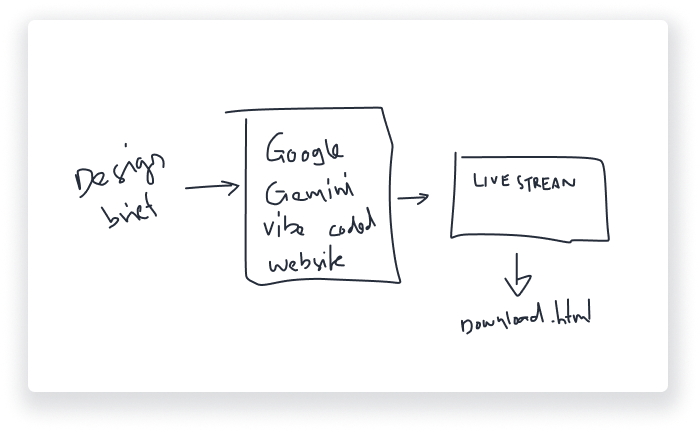
I am by no means a professional dev. Matter of fact, this was entirely “vibe coded” without ever really looking at the underlying syntax.
It was built in Google’s AI Studio and uses Gemini and Nano Banana. Everything is stored locally in the cache except the key, so sorry about that. What you see here is a demo, a rapid prototype. With the right prompts, you could probably rebuild this better in a few hours using their web tools.
The Learnings: Software as “Slow TV”
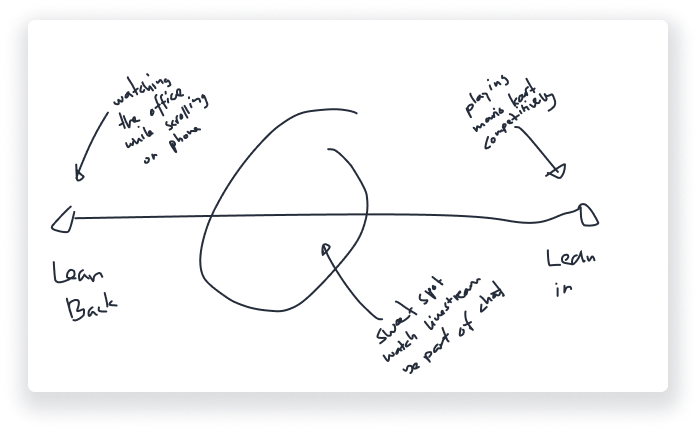
Vibe coding is wild. The fact that the output is decent is crazy, but the fact that I spent hours just watching them do the work made me realize something: There is a massive space for AI generation as an entertainment form itself.
We are so used to the “ChatGPT Typing” effect—text appearing digit-by-digit. It’s a skeuomorphism of a 1980s teletype, and honestly, it’s a bit of a dark pattern designed to hook you. I wanted to replace that with my made up term “Ambient Computing.”
Think of it like the “Slow TV” movement (those 7-hour train rides in Norway they broadcast on TV or the Yule Log) meets Twitch. Work and Leisure are a gradient. We move between “lean in” (competitive gaming, solving urgent tickets) and “lean back” (Netflix asking “are you still watching?”).
Agen+cy sits in the middle: You lean back to watch the drama, but you feel a sense of ownership because you signed the checks.
The “Sims” Effect
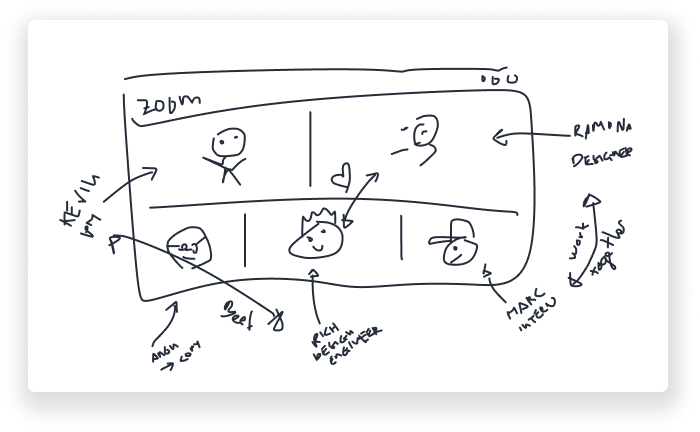
To make this work, I had to play around with the concept of chat. Conversation is the heartbeat of realism. I learned that prompting AI to write dialogue that feels natural is incredibly hard.
I realized I could trick myself into a lot more immersion just by integrating GIFs. It’s surprising how much a GIF does to help you “read into” the text; it adds the kinetic energy that text alone lacks. But the real magic happens when you treat the agents as characters rather than functions.
When Kevin asks for a “quick alignment,” and Rich responds with a frustrated GIF, it triggers the same part of my brain that made me care about my Sims back in the day. It’s low-fidelity emotion, but it works. (Side note: I think I need to hang out with some Game Devs; those guys are world-class at making NPCs feel alive).
The Director & The Wave Function
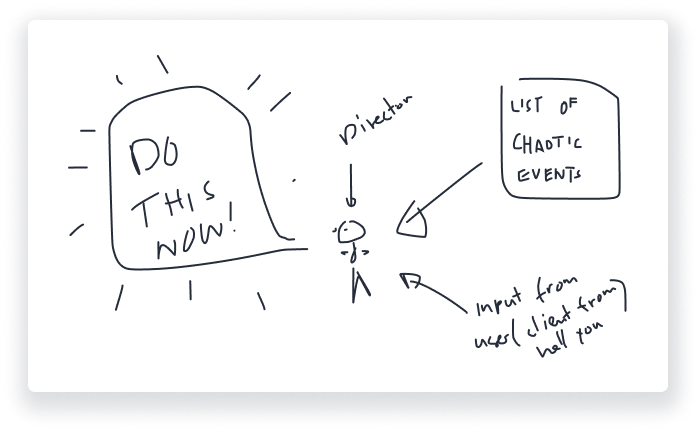
Sitcoms benefit from absurdity. I decided the prototype needed a “Director” agent behind the scenes pulling the strings.
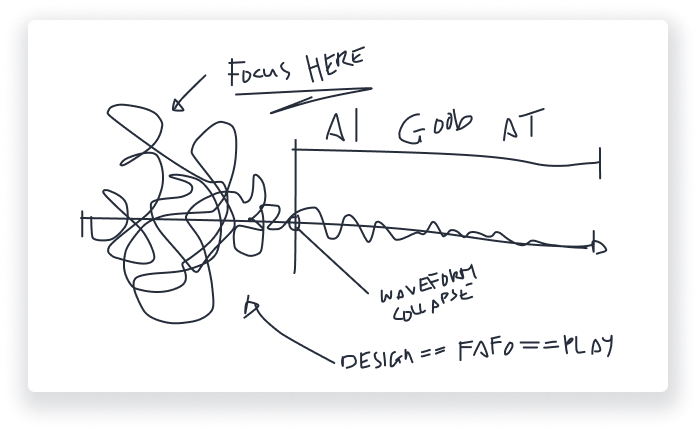
The Director reinforces the design process but also injects random events—like a sudden “client request”—to make the agents react. We are doing a disservice to LLMs by being hyper-focused on eliminating hallucinations. In a creative process, misunderstandings are features, not bugs. They add randomness. Think some of the biggest innovations are products of chance.
I’ve started thinking about the design process as a form of Quantum Physics: at the beginning, all ideas exist in a massive possibility space. Through sketching and discussing, you create boundaries that collapse the wave function. Randomness helps you explore boundaries you didn’t know existed. So why not add randomness intentionally to your AI? Hello, Innovation! =)
The Design Process (Skeuomorphism)
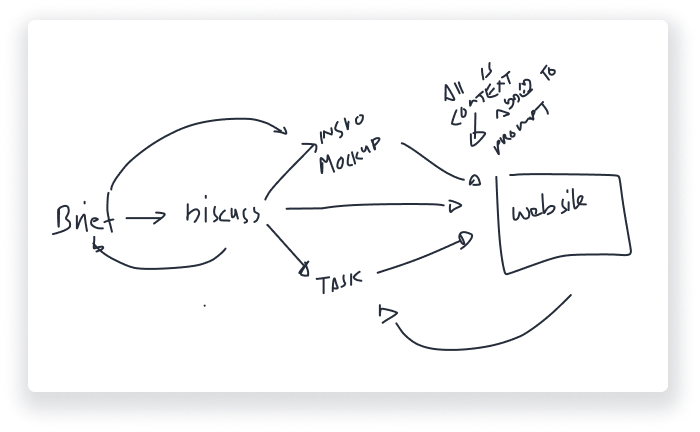
I had to figure out how to reinforce context so the agents would stick to a plan while still iterating. I realized I had to give them a clear workflow—essentially a “behind the scenes” script.
Since I’m simulating a design studio, I modeled it around a real design process. First, they dissect the brief. Then they write an expanded one. Then they ideate/find inspiration. Then they break it into To-Dos. Finally, they code. This is why it feels slow at the start (just like any creative process). This type of skeuomorphism helped me a lot—it gave the AI a structure to hang its “creativity” on.
Multi-Input and Context
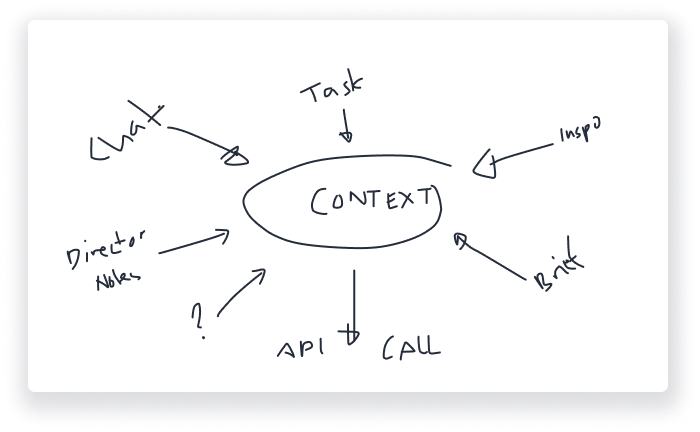
For an LLM to progress, it requires context. I’m not a computer scientist, so I don’t understand the magic, but what worked for me was allowing the model to pull context from multiple sources.
Since I call Gemini Pro and Nano Banana, they can understand and combine different inputs. They can pull from the To-Do Board, the Chat, the Inspiration board, and the Code itself. This keeps them on track. There is a lot more to explore here regarding weighting these inputs differently.
Immersion
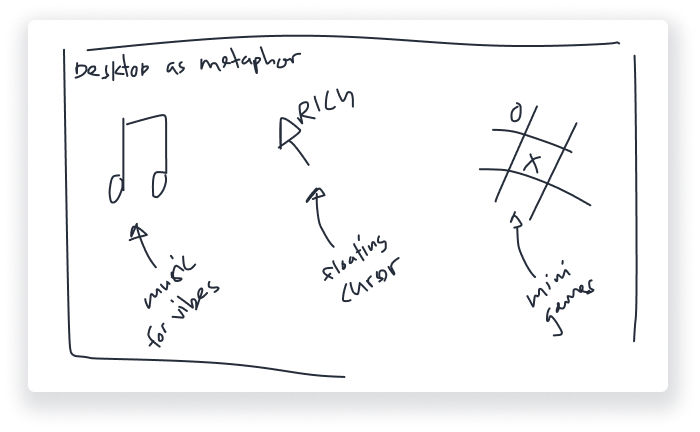
To make this entertaining, I needed that “Yule Log” energy—you just want to stare at it.
AI tools already do this with typing, but I wanted more. Since this lives in a Figma-like environment, I added invasive multiplayer live cursors. I even added a Tic-Tac-Toe game you can play against them. Seeing things move on screen is fascinating, even if it’s fake. It feels like watching fish in an aquarium.
I also added music. This is fun because you suddenly have an equalizer or a wave form, which you can use as input for prompts again (e.g., a lo-fi hip-hop beat that impacts the team’s mood).
The Canvas
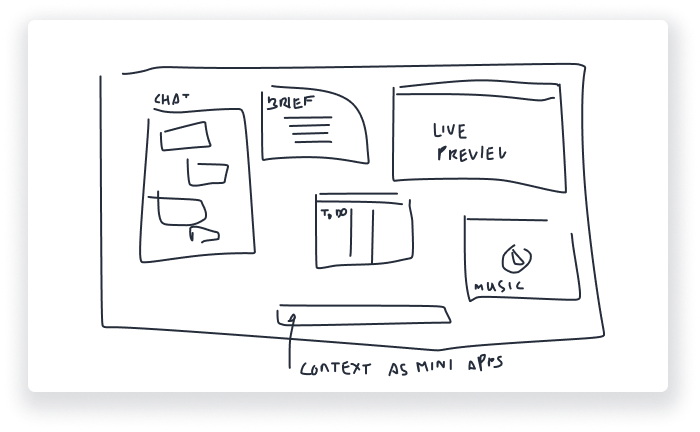
This brings me to a massive improvement: Changing to a canvas.
I fucking love canvas.
Spatial UIs open up an entire new play space. It feels more natural to have many things visible at once, and space creates immersion. It also added interaction for me as a viewer. We are just scratching the surface of metaphors that aren’t linear chat windows. Seeing cursors move, chat pop up, and inspiration land on a board allows for “fourth wall breaks.” Imagine if the agents could text you and ask for input? Suddenly you’re part of the show.
Future of Design
I had a moment where the agents built a landing page that was actually... fucking good. And honestly, it wasn’t “terrifying”—that’s a dramatic trope. It was just existentially rude.
It’s wild to build a toy for fun, only to watch it casually execute a task that used to take you three days of billable hours. But I’m optimistic. Think of the Camera. When it was introduced, portrait painting ceased to be a utility and became a luxury. But the camera unlocked film, cinema, magazines, and video games.
I think the standard “Landing Page” is going the way of the portrait painting. But this prototype showed me 100 potential spaces where design can return to its original form: Exploration.
Final Thoughts
My approach to this was simple: Make small things fast. Start over. Rinse and repeat.
The problem with most prompt-based tools is they force you to know the end result. They are teleological. I wanted something ontological—I wanted to see what happens when you put these ingredients together.
There is a ton to explore regarding how we engage with AI. There is so much more fun to be had when you stop thinking about simple bureaucracy automation and start thinking about digital coworkers.
If you want to chat, reach out to hej@ramonmarc.com.
Credits
This project has been brewing through hundreds of random prototypes. It was inspired by conversations with friends, playing way too many games, and watching The Office on repeat. Big thanks to Rich for being a thought partner along the way.
Links
=> Github
=> Examples
=> Drive Folder